Review: Low-Poly Christmas Sublimation Clipart for Stitching
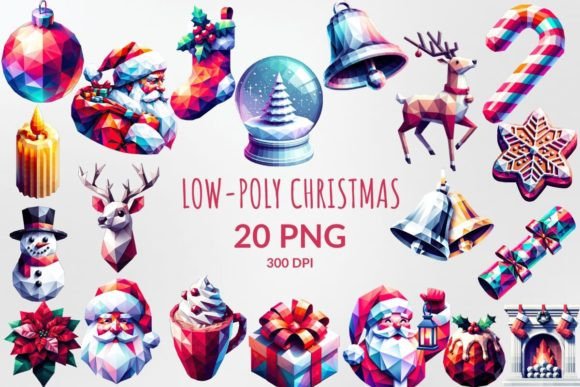
As a designer who spends half my life staring at digitized paths and the other half pulling thread jams out of a bobbin case, I have learned to be skeptical of trendy graphics. We see a lot of Low-Poly Christmas Sublimation Clipart floating around digital marketplaces these days. It is visually striking on a screen, with its sharp geometric facets and modern, faceted aesthetic. But does it translate to the needle? I recently pulled this specific set of Illustrations into my workflow to test its viability for a holiday client order, and the results were more nuanced than a simple yes or no.
The First Impression: Modern Geometry Meets Holiday Warmth
The immediate appeal of this design lies in its departure from traditional curvy, organic holiday motifs. Instead of soft snowflakes or rounded Santa bells, we are looking at angular, polygonal structures. This creates a mood that is crisp, contemporary, and slightly tech-forward. For a brand targeting a younger demographic or a boutique that favors minimalist decor, this visual personality is a goldmine. However, from an embroidery standpoint, those sharp angles are both the design’s greatest strength and its biggest challenge.
When I first loaded the file, I was looking for how the shapes would hold up under tension. In sublimation, gradients are smooth. In embroidery, we build gradients with thread density and color changes. The low-poly style relies on distinct blocks of color. This means the design naturally lends itself to clean fill stitch areas rather than complex shading. It feels intentional, not like a compromise.
Real-World Application: The Tote Bag Test
To truly evaluate the Low-Poly Christmas Sublimation Clipart, I needed a real project. I chose a heavy canvas tote bag, a staple for any Etsy seller during the holiday rush. The goal was to create a festive yet understated handmade product that could serve as a personalized gift or a chic small shop product.
I placed the central geometric tree motif in a 5x7 hoop. The result was surprisingly crisp. Because the design uses large, flat planes of color, it avoided the "muddy" look that sometimes happens when intricate details are compressed into a small space. The thread colors popped against the natural canvas, creating a high-contrast look that felt premium. Customers reacting to similar items in my shop tend to appreciate the clarity. It doesn’t look like a messy blob from three feet away; it looks like a deliberate graphic element.
This success translates well to other flat surfaces. A sweatshirt embroidery project using this clipart would work beautifully on the chest or back, provided the fabric is stable enough to support the stitch count. It also makes for a striking embroidered patch if you plan to cut and sew it onto denim jackets or hats later.
Where Caution Is Required
While the design shines on canvas and fleece, I would hesitate before using it on certain materials. The sharp corners inherent in low-poly art can be tricky on stretchy fabrics. If you are attempting baby embroidery on a soft, stretchy onesie, the dense stitching required to fill those geometric shapes might cause puckering. You would need a very robust stabilizer and perhaps a lighter touch with the stitch density settings if you are editing the embroidery file yourself.
Additionally, consider the hoop size. If you try to shrink this design down for a small cap or a tiny ornament, the individual polygons may become too small for the machine to render cleanly. The satin stitch borders, if used, might overlap or break. For curved surfaces like caps, ensure the design is centered and not too wide, as the stiffness of the filled areas can distort the fabric curve.
Dark fabrics present another consideration. Since this is originally sublimation clipart, it likely relies on light-to-medium tones for its effect. If you are stitching on black navy, you must ensure your thread colors have enough brightness to stand out. A dark green polygon next to a black background will vanish. Always test your palette.
Enhancing Brand Value and Visual Appeal
Using unique assets like Low-Poly Christmas Sublimation Clipart can significantly boost the perceived value of your finished product. In a sea of generic red-and-green snowflakes, a geometric, modern take on holiday themes signals that the maker is current and design-conscious. This builds customer trust and brand consistency for shops that focus on modern aesthetics.
For commercial embroidery projects, such as corporate holiday gifts or boutique branding, this style feels professional. It moves away from the "craft fair" vibe and into the "design studio" realm. When you present a printable mockup or a digital preview to a client, the clean lines of this design photograph exceptionally well. It engages buyers because it is instantly recognizable as high-quality design assets rather than clip-art clutter.
Practical Notes for the Embroidery Designer
Before you commit to a large production run, here are my practical recommendations for working with this type of graphic:
- Test on Scrap Fabric: Always run a test stitch-out on the exact material you plan to use. Check for puckering and thread breaks.
- Check Thread Contrast: Low-poly designs rely on the boundary between colors. Ensure adjacent thread shades are distinct enough to define the shapes.
- Review Stitch Density: If you are digitizing this yourself from the clipart, keep the density moderate. Too dense, and the fabric will stiffen; too light, and the backing will show through.
- Confirm Hoop Size: Match the design dimensions to your hoop. Do not force a large design into a small hoop by resizing it disproportionately.
- Inspect Small Details: Zoom in on the vector or image source. Are there tiny, isolated polygons? These might need to be merged or removed to prevent thread nests.
- Mockup in Black and White: Convert your preview to grayscale. If the shapes lose their definition without color, the design relies too heavily on hue rather than form.
- Licensing Verification: Since this is sold as sublimation clipart, confirm with the creator whether it includes rights for digital embroidery file creation and commercial sales of physical goods. Never assume.
Final Verdict
The Low-Poly Christmas Sublimation Clipart is a versatile tool for the modern maker. It bridges the gap between digital illustration and tactile craft. While it requires careful handling regarding fabric choice and scale, its potential for creating standout custom apparel, tote bag design elements, and holiday embroidery pieces is high. For the craft business owner looking to differentiate their Etsy listings with a fresh, geometric aesthetic, this design asset is worth the investment. Just remember: respect the geometry, choose your stabilizer wisely, and let the clean lines do the talking.